Night shift: Eleven calls; one false alarm, ten by ambulance.
Stats: 2 Collapsed ? cause; 1 Croup; 1 eTOH; 1 ? Drug overdose; 1 DIB; 1 Hypoglycaemia; 1 Chest pain; 1 RTC with ? # wrist.
Two and half hours to change a light bulb… that’s the answer. I waited for a minor repair to the car before being shipped off miles away to another area for a tail light, then it was business as usual for a night shift.
A crew was already on scene for a female who’d collapsed on a rail station concourse. She was laying curled up and refused to communicate with anyone, despite her obvious consciousness (her eyelids were flickering a lot). Then she suddenly broke out of her mood, grabbed my legs and wrapped herself around my lower half, crying out for her mother. She wouldn’t let go for some time and I wondered if she’d had some kind of emotional crisis, or perhaps had been robbed or assaulted – her behaviour was strange.
For another 30 minutes she kept mostly silent – even in the back of the ambulance when a female police officer was requested to talk to her (just in case that would help). She wrote down bits and pieces of information but otherwise refused to tell us why she was causing the fuss.
In the end, and with the crew exasperated by her stupidity, she was taken to hospital. I heard later on that she was told to leave after saying that her only problem was that her boyfriend had left her. This was a grown woman with issues.
Croup is characterised by a ‘barking’ cough and affects children at a young age. When I arrived at the home of a 7 year-old girl with such a cough, I recognised it immediately, as did the crew who heard her from the street. She had a history of ‘viral cough’, according to her parents, who’d had the foresight to put her in a steamy bathroom to ease it, but this was a bit worse than a tickly cough and she’d need to be seen at hospital.
Teenage drunks are becoming more and more common. My next call was for a 15 year-old who’d had too much to drink and who’d been found collapsed and unconscious in the toilet of a McDonald’s restaurant. Police were on scene and a crew was already there, so I wasn’t really required, except to assist. The girl’s mother had been called and she’d apparently told the police that her daughter ‘doesn’t usually drink a lot’. There was no anger or embarrassment in the statement.
Unfortunately her pride and joy was leaving the place with her trousers undone, vomit on her clothes and in her hair and the ‘floppy doll’ look in an ambulance carry chair. If only she could be sent video footage to cherish for years to come.
A call to an unconscious male at a pub provoked a rather over-the-top response for my request for police assistance when the man began to thrash out at me after I’d attempted to get him to wake up. He was slumped over a table in a quiet bar but I was told he hadn’t had a lot to drink, so I guessed he was homeless or very, very tired. I wasn’t in the mood for any aggression tonight, so after a few near-misses from his flailing fists I called for extra hands. For some reason, despite my answer to the standard question ‘do you want urgent police?’ being no and a further explanation to Control that I was okay but just needed cops in to help me control him, I was sent half the Met.
At least six police officers, including two armed cops, filed in to the bar, doubling its popularity – if they hadn’t been on duty the barman would have broken into a song.
Luckily, I needed at least three of them because when we woke the man up again, he lashed out even more. He was big and fairly strong, so it took a bit of effort and shouting (from the police) to keep him in check while I figured out what his problem was. As he slipped back into a deep sleep, I looked at his pupils – they were pin-point. This can mean nothing of course but given his demeanour it was best to delegate an option, so when the crew arrived I gave him IM Narcan. Within five minutes he was wide awake, abusive, aggressive and being dragged down the stairs to the waiting ambulance.
It always amazes me to see the clutter and untidiness of other people’s homes. I don’t mean general disorganisation – I’m talking about real trashy piled-on-high rubbish and as I struggled to get into the basement flat of my next patient, a 62 year-old woman with DIB, my bags knocked books and magazines onto the floor. I thought there was little chance of getting a chair in if we needed it (which we did) but somehow the crew managed to squeeze around the blockade. The woman wasn’t having any difficulty breathing anyway – she just said she did. She was quite rude at times; one of those well-spoken types that feel we are simply servants.
Hypoglycaemic patients are not a major issue for me and I have my own routine for treating them, especially if they are still conscious but difficult to manage. A call to a 50 year-old man who’d become semi-conscious when his blood sugar dropped to 1.3 (on my meter), meant I was struggling to keep him still as he periodically sat up, cried out and pulled away from me and the two people with him. Placing an IV line wasn’t going to happen until I had help, so I started him off with Glucagon but the crew arrived as I was about to give it. Things didn’t change with him though. He’d settled down a little but I’d been with him a few minutes now and he didn’t stay still for long, so I continued with the IM injection, giving only half – the dark room and stupid little syringe had combined to make me think all of the liquid had been drawn when it hadn’t – still, some was better than none and it would be in his system while I tried to get a line in.
Predictably, he struggled hard as I tried to put a cannula in and it was soon torn out of his vein as my colleague set up the 10% Glucose line I’d be putting in. Another half bolus of Glucagon would have been a good idea, especially if getting IV access was going to prove impossible. He needed to mobilise his own glucose if I couldn’t give him any of mine.
In the end, a second cannula went in and I managed to stick it in place long enough for 150ml of Glucose to run into his bloodstream. He recovered within a minute with an improved BM of 3.9 and from then on was completely manageable.
A MOP called an ambulance for a homeless man who had requested one for his chest pain. The MOP was cynical about it all and seemed to know what he was talking about; his handover was professional, so I figured he was a doctor or a nurse…or a medic. The man on the bridge just wanted a place to sleep and the crew obliged.
‘I just want checking out’, said the 49 year-old woman as she leaned against her kitchen table. She had suffered a panic attack earlier on and now had chest pain – well, it was more numbness down her arm, she admitted. She had no medical history of significance but I think depression was on the menu.
I wasn’t required for the ‘unconscious’ male on my next call because he wasn’t. The police were on scene and the not conscious man was walking away into the sunrise.
And again I wasn’t required for the 21 year-old female who collapsed for some unknown reason (her boyfriend probably left her), so this was another NPC.
I assisted a crew with a 43 year-old man who came off his motorcycle after colliding with a car on a bridge. There was a temporary traffic light system operating, allowing only one lane to run at a time but a private taxi driver chose to ignore his red signal and ploughed into the poor bloke, throwing him off his machine at speed. Now he was being collared and boarded for the ride to hospital. By the time I had finished my paperwork, the sun was up and I was going home.
Be safe.
Tuesday, 31 March 2009


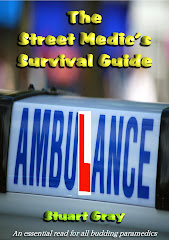
The new book
 The Street Medic's Survival Guide.
This is the next title and it should be ready at the end of April for launch in May this year. It's aimed at student paramedics and everyone with an interest in the profession and I hope it will serve as a useful reference in highlighting the realities of the job. Here's a quick synopsis!
The Street Medic's Survival Guide has been written by an experienced frontline paramedic to fill a void that exists for everyone embarking on the journey into the profession. Even if you are just thinking about becoming a paramedic, this book will take you through the realities of the job - the stuff they don't tell you in training school or university.
Written with humour and common sense by the author of 'A Paramedic's Diary - Life and Death on the Streets', the book will open your eyes before you embark on the long, arduous training programme that is standard for paramedics-to-be. Everything you need to know about 'out there' is in here, including:
> The recruitment and training process
> Salary and work conditions
> How to use the radio properly without making a fool of yourself
> How to wear uniform properly, including how to iron it!
> Call types and how to handle stress
With illustrations and real-life examples throughout, this book is destined to become the 'how to' bible of paramedicine.
Written with humour and common sense by the author of 'A Paramedic's Diary - Life and Death on the Streets', the book will open your eyes before you embark on the long, arduous training programme that is standard for paramedics-to-be. Everything you need to know about 'out there' is in here, including:
> The recruitment and training process
> Salary and work conditions
> How to use the radio properly without making a fool of yourself
> How to wear uniform properly, including how to iron it!
> Call types and how to handle stress
With illustrations and real-life examples throughout, this book is destined to become the 'how to' bible of paramedicine.
You can pre-order the book by emailing me (not through the comments section please) or going to SP services and, hopefully by the middle of April, Amazon and all the usual outlets. The book will cost £9.99 - a bargain!
Once this book is out I'm going to get my head into the novel, which I hope to finish by Autumn this year - hopefully before I have a heart attack.
Xf
Sunday, 29 March 2009
Blunt trauma

Day shift: Nine calls; one treated on scene, three taken by car, the rest by ambulance.
Stats: 1 Punctured foot; 1 Collapse ? drugs; 1 Abdo pain; 1 Faint and sprain; 1 Febrile convulsion; 1 Bleeding PR; 2 Falls; 1 Chest pain.
I was in another TV studio this morning; this time it was the live-feed room where dozens of monitors decorate the walls. I was there to see a 34 year-old man who’d been on the roof of the building (adjusting something) when he stood on a blunt metal spike (see pic - the tape marks how deep it had gone into his foot), which travelled through his trainer and into his foot. The wound was small and had stopped bleeding by the time I arrived, so all I had to do was dress it and advise him about Tetanus. He declined to go to hospital and I agreed that he could wait until later on – it wasn’t life-threatening and his foot had good movement and sensation. That must have been painful though.
A man collapsed in a gay sauna and I was asked to join the crew to investigate. I arrived and found the male-female crew standing in a small crowd of naked men. Not half-naked but naked. Gay men aren’t shy.
I spent most of my time doing what the female crew member was doing – looking at the pretty walls and averting my eyes. Meanwhile the man who’d collapsed was recovering but it looked like he’d taken something, probably GHB. He was taken to hospital after a long, persuasive conversation.
An art gallery next for a 55 year-old woman with severe abdominal pain. She had no medical history and the pain seemed to be located over her Liver, an area that was particularly tender to palpation, so I gave her entonox and walked her carefully to the car with her friend. By the time she was at hospital, a big smile had replaced the grimace of pain. Entonox has some unusual psychological side effects.
Heat was also the theme for this next call, to a 31 year-old woman who’d fainted during a ‘heated yoga’ class. On the way down, she’d twisted her ankle badly and now had a sprain to cope with. I arrived to find her being nursed with ice packs and elevation (a good combination for this kind of injury). She found it impossible to weight-bear and getting her to the lift (we were in a basement) proved slow and painful, so I gave her entonox for a few minutes before we set off again.
On the way out this well-spoken young woman described the feeling of having the gas as ‘custard on her lungs’, which I found highly amusing and original. We chatted all the way to hospital – she had a soft voice and I thoroughly enjoyed listening to her talk.
I left her in the care of the x-ray department and bid her farewell.
A NPC call for a 2 month-old baby who was fitting next. I wasn’t needed at all because there was a MRU and crew on scene but I guess all the bases were being covered.
Two minutes from a hospital, a man sat in the doorway of Burger King complaining of a PR bleed and that he was going to faint. At first, to be honest, I didn’t think I could take him seriously but he seemed to have a genuine history. He’d bled on the toilet last night and now he felt that it was ‘all wet’ down there. He worked out in the gym five days a week and I wondered if he’d ruptured something or if a prolapse had occurred. In the middle of the day and in a public area, I don’t think it would have been prudent to have a look, so I got him into the car and took him up to the end of the road and into A&E.
A lovely 84 year-old granny was showing her grandson around London when she tripped and fell, cutting her hand open. She was at an underground station and I dressed her wound and joked to her about the possibility that she might have done it deliberately to get attention.
She was quite cold but otherwise not too concerned about her injury, so I took her and the boy to hospital.
My next call was also a NPC. A crew and MRU colleague were on scene with a 29 year-old man who’d fallen asleep while standing at the edge of a railway platform. He fell onto the tracks, got up and clambered out. He was very lucky not to have touched the live rail or timed it to coincide with a train coming. I wonder how many ‘suicides’ have died accidentally this way.
My last call was for a 28 year-old man with chest pain. He’d had an MI before as the result of cocaine use, so I was taking him seriously when he told me that his left arm was numb, just as it had been before. The crew was on scene as I carried out my obs and his ECG didn’t show anything alarming, so he was taken to hospital without fuss.
I’m finding that working on the amber car is so much better for my stress levels. I am talking to clinical human beings and not being pushed around like a pawn. I’m working in my own area and seldom have to travel miles away into other sectors and I get to spend time with my patients, something I miss when working on the sector FRU. I now have three nights coming up and will have to contend with working that way again for a while.
Stats: 1 Punctured foot; 1 Collapse ? drugs; 1 Abdo pain; 1 Faint and sprain; 1 Febrile convulsion; 1 Bleeding PR; 2 Falls; 1 Chest pain.
I was in another TV studio this morning; this time it was the live-feed room where dozens of monitors decorate the walls. I was there to see a 34 year-old man who’d been on the roof of the building (adjusting something) when he stood on a blunt metal spike (see pic - the tape marks how deep it had gone into his foot), which travelled through his trainer and into his foot. The wound was small and had stopped bleeding by the time I arrived, so all I had to do was dress it and advise him about Tetanus. He declined to go to hospital and I agreed that he could wait until later on – it wasn’t life-threatening and his foot had good movement and sensation. That must have been painful though.
A man collapsed in a gay sauna and I was asked to join the crew to investigate. I arrived and found the male-female crew standing in a small crowd of naked men. Not half-naked but naked. Gay men aren’t shy.
I spent most of my time doing what the female crew member was doing – looking at the pretty walls and averting my eyes. Meanwhile the man who’d collapsed was recovering but it looked like he’d taken something, probably GHB. He was taken to hospital after a long, persuasive conversation.
An art gallery next for a 55 year-old woman with severe abdominal pain. She had no medical history and the pain seemed to be located over her Liver, an area that was particularly tender to palpation, so I gave her entonox and walked her carefully to the car with her friend. By the time she was at hospital, a big smile had replaced the grimace of pain. Entonox has some unusual psychological side effects.
Heat was also the theme for this next call, to a 31 year-old woman who’d fainted during a ‘heated yoga’ class. On the way down, she’d twisted her ankle badly and now had a sprain to cope with. I arrived to find her being nursed with ice packs and elevation (a good combination for this kind of injury). She found it impossible to weight-bear and getting her to the lift (we were in a basement) proved slow and painful, so I gave her entonox for a few minutes before we set off again.
On the way out this well-spoken young woman described the feeling of having the gas as ‘custard on her lungs’, which I found highly amusing and original. We chatted all the way to hospital – she had a soft voice and I thoroughly enjoyed listening to her talk.
I left her in the care of the x-ray department and bid her farewell.
A NPC call for a 2 month-old baby who was fitting next. I wasn’t needed at all because there was a MRU and crew on scene but I guess all the bases were being covered.
Two minutes from a hospital, a man sat in the doorway of Burger King complaining of a PR bleed and that he was going to faint. At first, to be honest, I didn’t think I could take him seriously but he seemed to have a genuine history. He’d bled on the toilet last night and now he felt that it was ‘all wet’ down there. He worked out in the gym five days a week and I wondered if he’d ruptured something or if a prolapse had occurred. In the middle of the day and in a public area, I don’t think it would have been prudent to have a look, so I got him into the car and took him up to the end of the road and into A&E.
A lovely 84 year-old granny was showing her grandson around London when she tripped and fell, cutting her hand open. She was at an underground station and I dressed her wound and joked to her about the possibility that she might have done it deliberately to get attention.
She was quite cold but otherwise not too concerned about her injury, so I took her and the boy to hospital.
My next call was also a NPC. A crew and MRU colleague were on scene with a 29 year-old man who’d fallen asleep while standing at the edge of a railway platform. He fell onto the tracks, got up and clambered out. He was very lucky not to have touched the live rail or timed it to coincide with a train coming. I wonder how many ‘suicides’ have died accidentally this way.
My last call was for a 28 year-old man with chest pain. He’d had an MI before as the result of cocaine use, so I was taking him seriously when he told me that his left arm was numb, just as it had been before. The crew was on scene as I carried out my obs and his ECG didn’t show anything alarming, so he was taken to hospital without fuss.
I’m finding that working on the amber car is so much better for my stress levels. I am talking to clinical human beings and not being pushed around like a pawn. I’m working in my own area and seldom have to travel miles away into other sectors and I get to spend time with my patients, something I miss when working on the sector FRU. I now have three nights coming up and will have to contend with working that way again for a while.
Be safe.
Friday, 27 March 2009
The fall guy
Day shift: Seven calls; six taken by car, one by ambulance.
Stats: 1 Unwell person; 1 Panic attack; 4 head injuries; 1 Cardiac arrest.
A 34 year-old woman felt unwell at an underground station but she had no medical history. She was cold and had numb hands – she’d almost fainted too. Now she was recovering, apart from the numbness, so I took her in the car to hospital, where I doubt anything of significance will be diagnosed.
Having a large family at a young age is bound to be stressful – a call to a 28 year-old woman who was having a panic attack took me to a flat in which three children were running around and another two were somewhere in the area but too young to be noticeable. The mother was slumped on the sofa as her boyfriend attempted to keep a rein on the family Von Trapp as they shouted, screamed, cried and noisily stomped about.
I could see this lady’s depression without diagnosing it. She would speak and cry intermittently, often repeating the phrase ‘but I’m alright, really’. If I touched her hand, even to take her pulse, she’d weep. She was clearly unable to cope with her present situation, so I convinced her to go to hospital with me – even if all she got was peace and quiet it would help, I thought.
The flat was bare-floored and the stairwell was open, so the toddlers could toddle right on over them if they wished. I think her state of mind left the children vulnerable but I was going to leave that to the judgment of the doctor.
Falls seem to be the theme this week. I went to the aid of a 68 year-old man who fell at a train station, cutting his forehead open. He wasn’t knocked out and had no other injury, so I took him to A&E for the benefit of a few stitches.
I overheard a call on the radio in which five police officers were trapped inside their vehicle after a RTC involving another car. It sounded serious and a lot of resources were sent, including some that had turned up without invitation. As soon as a job like that is GB’d, you can bet the green-mobile button will be pushed on dozens of vehicles.
My next fall was a 68 year-old woman who’d tripped on the pavement and smashed her nose and forehead on the concrete as she landed. Her husband was with her and I travelled three miles to get to them, as they sat on a wooden chair by some skips in the road. The lady was a little distressed but her bleeding was controlled and a dressing wasn’t required. I took them both to hospital across the river. Obviously I used the bridge.
Then a call for a collapsed woman in a large toy store came through as I sat on stand-by. It was cancelled then re-sent as a Red1 cardiac arrest. I got on scene to find a MRU colleague and another FRU paramedic working on a woman who was now breathing for herself, albeit agonally. She’d arrested and been shocked back to life after a couple of customers (who happened to be nurses) had initiated CPR. This action had saved the woman’s life without doubt but as I assisted the medics and another crew appeared to take her away, I wondered where the first aider for the store was. Nobody had created a corridor through the mass of customers so that the trolley and equipment could be moved and it was business as usual outside as a clown (or some sort of dressed up character) blew bubbles into the air.
When the poor woman was taken to the ambulance, not only did the crew have to fight their way out the door but bubbles landed on top of her as she was taken away. When they arrived at hospital (I had gone in the car because the MRU paramedic would need to go back to his bike) a nurse opened the back doors of the ambulance and bubbles floated out into the air as the critical patient was brought out!
If this had been my mother (her daughter was with her and witnessed everything) I would have been livid at the indignity of it all.
Another head injury and this time the man just wasn’t looking where he was going, although I have a feeling he wanted to use his minor wound as an excuse to sue McDonald’s. The 40 year-old was walking up the stairs and avoided the cleaner, who was at the top, by moving to his right a little. A barrier, secured at the end with foam and striped tape to warn people of its existence, made contact with the top of his head and the only way that could have happened is if he had been watching his feet instead of where he was going (in my opinion). As if to prove my theory, on the way to the car I had to warn him several times to look up as he bumped into people and almost walked straight into a post.
Two helpful young women waited with a 79 year-old woman who’d tripped outside a shop and fallen, cutting her forehead. It was a very minor injury but the patient was unable to walk properly as the result of a knee problem, so she stayed where she landed until I arrived.
I helped her to the car and took her to hospital, after thanking the ladies who had taken the time to care for her as the security people in the shop simply stared out vacantly.
Be safe.
Stats: 1 Unwell person; 1 Panic attack; 4 head injuries; 1 Cardiac arrest.
A 34 year-old woman felt unwell at an underground station but she had no medical history. She was cold and had numb hands – she’d almost fainted too. Now she was recovering, apart from the numbness, so I took her in the car to hospital, where I doubt anything of significance will be diagnosed.
Having a large family at a young age is bound to be stressful – a call to a 28 year-old woman who was having a panic attack took me to a flat in which three children were running around and another two were somewhere in the area but too young to be noticeable. The mother was slumped on the sofa as her boyfriend attempted to keep a rein on the family Von Trapp as they shouted, screamed, cried and noisily stomped about.
I could see this lady’s depression without diagnosing it. She would speak and cry intermittently, often repeating the phrase ‘but I’m alright, really’. If I touched her hand, even to take her pulse, she’d weep. She was clearly unable to cope with her present situation, so I convinced her to go to hospital with me – even if all she got was peace and quiet it would help, I thought.
The flat was bare-floored and the stairwell was open, so the toddlers could toddle right on over them if they wished. I think her state of mind left the children vulnerable but I was going to leave that to the judgment of the doctor.
Falls seem to be the theme this week. I went to the aid of a 68 year-old man who fell at a train station, cutting his forehead open. He wasn’t knocked out and had no other injury, so I took him to A&E for the benefit of a few stitches.
I overheard a call on the radio in which five police officers were trapped inside their vehicle after a RTC involving another car. It sounded serious and a lot of resources were sent, including some that had turned up without invitation. As soon as a job like that is GB’d, you can bet the green-mobile button will be pushed on dozens of vehicles.
My next fall was a 68 year-old woman who’d tripped on the pavement and smashed her nose and forehead on the concrete as she landed. Her husband was with her and I travelled three miles to get to them, as they sat on a wooden chair by some skips in the road. The lady was a little distressed but her bleeding was controlled and a dressing wasn’t required. I took them both to hospital across the river. Obviously I used the bridge.
Then a call for a collapsed woman in a large toy store came through as I sat on stand-by. It was cancelled then re-sent as a Red1 cardiac arrest. I got on scene to find a MRU colleague and another FRU paramedic working on a woman who was now breathing for herself, albeit agonally. She’d arrested and been shocked back to life after a couple of customers (who happened to be nurses) had initiated CPR. This action had saved the woman’s life without doubt but as I assisted the medics and another crew appeared to take her away, I wondered where the first aider for the store was. Nobody had created a corridor through the mass of customers so that the trolley and equipment could be moved and it was business as usual outside as a clown (or some sort of dressed up character) blew bubbles into the air.
When the poor woman was taken to the ambulance, not only did the crew have to fight their way out the door but bubbles landed on top of her as she was taken away. When they arrived at hospital (I had gone in the car because the MRU paramedic would need to go back to his bike) a nurse opened the back doors of the ambulance and bubbles floated out into the air as the critical patient was brought out!
If this had been my mother (her daughter was with her and witnessed everything) I would have been livid at the indignity of it all.
Another head injury and this time the man just wasn’t looking where he was going, although I have a feeling he wanted to use his minor wound as an excuse to sue McDonald’s. The 40 year-old was walking up the stairs and avoided the cleaner, who was at the top, by moving to his right a little. A barrier, secured at the end with foam and striped tape to warn people of its existence, made contact with the top of his head and the only way that could have happened is if he had been watching his feet instead of where he was going (in my opinion). As if to prove my theory, on the way to the car I had to warn him several times to look up as he bumped into people and almost walked straight into a post.
Two helpful young women waited with a 79 year-old woman who’d tripped outside a shop and fallen, cutting her forehead. It was a very minor injury but the patient was unable to walk properly as the result of a knee problem, so she stayed where she landed until I arrived.
I helped her to the car and took her to hospital, after thanking the ladies who had taken the time to care for her as the security people in the shop simply stared out vacantly.
Be safe.
Thursday, 26 March 2009
Labradors are thick
 If warnings have no consequences, the result is always the same.
Day shift: Five calls; all taken by car.
Stats: 1 Epistaxis; 1 Testicular pain; 1 Abdo pain; 1 eTOH; 1 Allergic reaction.
Another nosebleed start to my day. An Italian man stood in his kitchen with his wife and a large, fat chocolate Labrador, as he bled into tissues. The sink was covered in blood and many more crimson tissues lay inside it. He’d been bleeding for over an hour and couldn’t get it to stop.
The man had a cardiac history and was on anti-coagulant drugs but he’d been able to stop the bleeding when it had happened before. He was due to see an ear-nose-throat specialist about his recurrent epistaxis.
As the chunky dog attempted to jump up at me (unfortunately he was too fat to get his two front paws very far off the floor) I packed the patient’s nostril and swathed his nose in a dressing. That seemed to do the trick and I got him ready for the short car journey to hospital.
As we left the house (his wife accompanied us) he told me how much he loved his dog but that it was ‘thick’...'lovely but thick', he said. I agreed that the friendly mutt was thick in terms of its waistline but I couldn’t comment on its intelligence as I hadn’t had a conversation with it.
On the way to hospital, through ever-slowing rush-hour traffic, the man began to cough and splutter as blood leaked into his throat and through the dressing. I advised Control that I would be pushing through the traffic on lights because I didn’t want my patient to pass out in the back of the car and that got me to A&E within three minutes (it may have taken ten or fifteen otherwise).
A 42 year-old chef had an acute onset of testicular pain which radiated into his groin and perineum. He’d had this before but his GP had diagnosed nothing, so he was left to wait for the next attack, which was now.
I found him on the floor in agony, bent double and cupping his scrotum with his hand, just like you do when you are hit there with a football...or a boot. If you are a female reader, please refer to any manual on the pain of childbirth and get back to me on this.
I asked him if it was similar to the pain you get when kicked there and he shrugged his shoulders. Every other male in the room knew what I was talking about but he, apparently, had never been hit there in his life. I found that strange. Even a light tap to the area can produce agonising pain for a short time...every boy knows this.
Anyway, there he was on the floor and I had to get him up, walk him out and put him on entonox before he finally calmed down. He had no medical problems and denied any recent traumatic event. My guess at the time was testicular torsion but my cursory exam of the area couldn’t conclude on that theory as it’s an internal problem.
Remember when you were growing up and all sorts of aches and pains plagued your body until somebody used the phrase ‘growing pains’ and it seemed logical? My next call was for a 13 year-old girl with chest pain and I knew I was running to an inaccurate call description, either in symptom or age. The young French-speaking teen was in an art gallery with her teacher. She was sitting on the floor, chatting away and looking healthy. I used my minimal French to start communication with her until I ran out of steam (and the French language) and had to refer to her English teacher for translation.
The girl had muscular pains of a general nature – not chest pains. Her earlier hyperventilation had produced other symptoms and that’s what prompted the emergency call. I suggested growing pains because she was very tall for her age and looked like she was heading for over 6 feet in height when she stopped developing. Her muscles must be under a lot of stress as they stretch to catch up.
I took them both to hospital in the car. You can never be too sure with these things I guess.
A drunken homeless man broke into a ‘secure’ television news centre and I was sent to get him out. He had somehow snuck in and settled down on the toilet in the executive loos, much to the consternation of the suited managers as they came and went. Security tried to deal with him but he demanded an ambulance.
He was slumped on the loo seat with a sandwich on the floor beneath him; laid there like a loyal puppy at his feet – a bacon and lettuce puppy. I woke him up and he told me he had ‘ligament pain’ so needed to be in hospital. I cancelled the ambulance and decided to take him myself. He was smelly and generally unclean but the trip would only take ten minutes and the options were limited – he could go by ambulance and waste tax-payer’s money or I could simply take him outside and leave him but he’d generate another call for sure. The police could come and collect him but, apart from trespassing, he’d done nothing wrong. So, the only viable option was to take him to a place of safety - still a waste of tax money but cheaper than an ambulance and crew.
During the trip (which lasted forever because of the traffic), he mumbled to himself. Sometimes he spoke to me but I didn’t really listen to him; I was keeping a wary eye on him in case he decided to misbehave and the smell was blurring my focus. So the journey dragged on and all I could hear eventually was mumble, mumble, mumble...snore! The cheeky git was asleep and it took me ages to wake him up and get him out of the car when I got to A&E.
A late job (again) for a 19 year-old girl who was having an allergic reaction in the street. Her friend was with her and, although they were both going to hospital in the car, their boss didn’t believe them, preferring to think they were skiving for the night. He’d called to find out what they were doing and when the situation was explained to him (I’d even offered to speak to him myself but he wasn't interested), he was more concerned about losing a client. I guess in today’s economic climate that’s understandable but the girl’s skin was covered in an urticarial rash – there was no way she could work behind a bar like that.
She had an Epipen but knew not to use it unless her airway was threatened, which it wasn’t, so I scooted her off to A&E for the necessary antihistamine she’d require. Unfortunately (and this has happened to her before) by the time we got there, she didn’t look as if she needed anything – her rash was disappearing. She and her friend had to sit in the crowded waiting area. They’d be there for hours and probably not get anything more than the evidence they needed to convince their mean boss that she was actually unwell.
Be safe.
Wednesday, 25 March 2009
Two-wheeled collisions
Day shift: Ten calls; two taken by car; eight by ambulance.
Stats: 1 Epistaxis; 2 RTC; 1 Head injury; 1 Near faint; 1 SOB; 1 Actual faint; 2 Chest pain; 1 Fall with ? broken nose.
Nosebleeds are not usually emergencies (although I have seen one patient die as he bled out) unless the patient has a particular vulnerability, such as so-called ‘blood thinning drugs’ or high blood pressure, so I usually convey them to hospital myself. My 62 year-old patient was on Warfarin and Aspirin, so fell into the vulnerable category but he had only been bleeding for 30 minutes before I arrived and had no significant clinical signs or symptoms to worry about. The trip was fast and easy for him. I had packed and dressed around the left nostril and this brought an end to his drama.
My first RTC of the day was a motorcycle versus a cycle. The crew was on scene and another call had come in reporting yet another cyclist on the road after being hit, so I freed myself up (this patient had few or no injuries) in case I was needed elsewhere…
…I was but in a police cell for a 30 year-old man who’d deliberately banged his head on the wall, slipped to the floor and pretended to be unconscious. He wouldn’t speak at all but he mumbled convincingly. His mumbles were meant to say ‘I am having a fit’ but he clearly wasn’t. The cops weren’t buying it but they were being cautious. He was known to be violent (a fact they kept from me until I had provided a bit of pain to get a response), so I was suspicious about his motives.
The crew arrived and delivered a bit more pain than I was willing to after the ‘violent’ revelation. He sat upright, opened his lazy eyes and stared with contempt at the paramedic who had cruelly snapped him out of it. I didn’t mind; I wasn’t wimping out, I just had time to play with because he wasn’t going in the car with me.
He continued to play the part and was taken to hospital. I was still unconvinced and later learned that he tried to abscond after lashing out at staff. Told you, didn’t I?
The next RTC involved yet another cyclist and another motorbike – it was obviously day of the Lemming cyclists or day of the demon motorcyclists (they should really wear a badge so that I can tell what kind of day it is). The cyclist and motorcyclist veered toward one another in an attempt to miss each other on the road but ended up sandwiched together... and into the back end of a car they went. The car driver, a lovely lady who helped no end and tried to get me a free coffee but was refused (thanks Costa), was a bit shaken up and even more so when she was read her rights, along with the two competing two-wheeled idiots. She had done absolutely nothing wrong – indeed she was accosted by the two vehicles while her car simply obeyed the law but the police are required to cover all their bases. I felt sorry for her as she sat in the van getting the third degree.
The cyclist had minor scrapes to his leg but because he was the only injured party, he used this as an excuse to get the hell out of there by ambulance. While I was attending to him the two men argued the toss about who was to blame. Meanwhile the poor coffee-cadging woman stood nearby wondering what the hell was going on. Bless her.
A 70 year-old man almost passed out as he wandered an art gallery. It had happened to him before after a run (not bad at his age) but he had no heart problems. His ECG wasn’t normal and his blood pressure remained low so he was taken to hospital.
An interesting chest pain call at a walk-in centre produced a hidden problem that screamed to be diagnosed. The middle-aged man had gone in after a few days of chest pain, followed by progressive weakness and shortness of breath. He was pulling away on inspiration when I got there but he said he felt okay now. His obs were good except for a consistently high BP. His lungs seemed fairly clear, although I detected a small area of possible fluid in there, so I asked the crew to give GTN and nebulise him. This had the effect of reducing his BP and making him feel better about his breathing. The BP reduction wasn’t good enough though and I had already ruled out LVF, so what could it be? His ECG showed a T wave inversion on a lead where normality should be seen, so I had them swapped over to check again and there it was.
We blued him in even though he said he felt much better and a diagnosis was soon given – he had a Pulmonary Embolism. All the signs were there and so I should really have opened my mouth to say it but we are all a little shy of being smart arses to doctors sometimes.
A 60 year-old who fainted in a pub had a high blood pressure too and although she was recovering when I got there, she remained ill-looking to me and the crew, so she went to hospital. I thought it was a bit cruel to send me to a busy pub at lunchtime when I had already asked for a break and was starving. Plates of food were being sent out all around me and I might have stolen something if it wasn’t for my good manners and professionalism. And fear of arrest.
In the pouring rain and howling wind the last thing you want to do is wander around a horrible housing estate trying to find the flat number you need. As usual, the one I wanted was in the very last block, at the very top (no lift) and at the very end of the balcony. It was one number short of the easiest flat to access downstairs on the corner I had come in on.
I huffed and puffed my way up, mainly for effect and through annoyance, to the 65 year-old lady with a history of AF and flutter who’d claimed chest pain. She was on the sofa in the correct pose for ambulance assistance but all her obs were fine. Her pain had gone but the family remained concerned nonetheless. Of she went to hospital – carried down all those wet stairs by the valiant (and I mean that) crew that had also lost themselves in the weather trying to reach us.
Back to that walk-in centre for a 63 year-old man with chest pain and a pacemaker that might not have been pacing at all. He had left arm and shoulder pain but seemed reasonably stable. His pacemaker had been fitted only 6 months ago, so there may be a problem with it.
I conveyed my last patient of the day. She made me late home again but I forgive her. She had been drinking all day and fallen flat on her face, breaking her nose. I asked her why she had been drinking at this time of day (it was entering rush hour) and she said ‘Oh, you know…just because’ and that answered my question. She was depressed or angry about something and it was very likely something to do with the engagement ring on her finger.
She was a type I diabetic and her blood sugar was high. I told her how silly she was and she giggled acceptance of that fact while holding on for dear life to the back seat because she thought the car was spinning and leaning out of the open window preparing to vomit in the street. I asked her to put her head into a clinical waste bag and hold back the tears if she could. She ended up in A&E reception, sitting on a chair with her head so well buried that she looked like she had a yellow plastic bag for a face. She cried anyway.
Be safe.
Stats: 1 Epistaxis; 2 RTC; 1 Head injury; 1 Near faint; 1 SOB; 1 Actual faint; 2 Chest pain; 1 Fall with ? broken nose.
Nosebleeds are not usually emergencies (although I have seen one patient die as he bled out) unless the patient has a particular vulnerability, such as so-called ‘blood thinning drugs’ or high blood pressure, so I usually convey them to hospital myself. My 62 year-old patient was on Warfarin and Aspirin, so fell into the vulnerable category but he had only been bleeding for 30 minutes before I arrived and had no significant clinical signs or symptoms to worry about. The trip was fast and easy for him. I had packed and dressed around the left nostril and this brought an end to his drama.
My first RTC of the day was a motorcycle versus a cycle. The crew was on scene and another call had come in reporting yet another cyclist on the road after being hit, so I freed myself up (this patient had few or no injuries) in case I was needed elsewhere…
…I was but in a police cell for a 30 year-old man who’d deliberately banged his head on the wall, slipped to the floor and pretended to be unconscious. He wouldn’t speak at all but he mumbled convincingly. His mumbles were meant to say ‘I am having a fit’ but he clearly wasn’t. The cops weren’t buying it but they were being cautious. He was known to be violent (a fact they kept from me until I had provided a bit of pain to get a response), so I was suspicious about his motives.
The crew arrived and delivered a bit more pain than I was willing to after the ‘violent’ revelation. He sat upright, opened his lazy eyes and stared with contempt at the paramedic who had cruelly snapped him out of it. I didn’t mind; I wasn’t wimping out, I just had time to play with because he wasn’t going in the car with me.
He continued to play the part and was taken to hospital. I was still unconvinced and later learned that he tried to abscond after lashing out at staff. Told you, didn’t I?
The next RTC involved yet another cyclist and another motorbike – it was obviously day of the Lemming cyclists or day of the demon motorcyclists (they should really wear a badge so that I can tell what kind of day it is). The cyclist and motorcyclist veered toward one another in an attempt to miss each other on the road but ended up sandwiched together... and into the back end of a car they went. The car driver, a lovely lady who helped no end and tried to get me a free coffee but was refused (thanks Costa), was a bit shaken up and even more so when she was read her rights, along with the two competing two-wheeled idiots. She had done absolutely nothing wrong – indeed she was accosted by the two vehicles while her car simply obeyed the law but the police are required to cover all their bases. I felt sorry for her as she sat in the van getting the third degree.
The cyclist had minor scrapes to his leg but because he was the only injured party, he used this as an excuse to get the hell out of there by ambulance. While I was attending to him the two men argued the toss about who was to blame. Meanwhile the poor coffee-cadging woman stood nearby wondering what the hell was going on. Bless her.
A 70 year-old man almost passed out as he wandered an art gallery. It had happened to him before after a run (not bad at his age) but he had no heart problems. His ECG wasn’t normal and his blood pressure remained low so he was taken to hospital.
An interesting chest pain call at a walk-in centre produced a hidden problem that screamed to be diagnosed. The middle-aged man had gone in after a few days of chest pain, followed by progressive weakness and shortness of breath. He was pulling away on inspiration when I got there but he said he felt okay now. His obs were good except for a consistently high BP. His lungs seemed fairly clear, although I detected a small area of possible fluid in there, so I asked the crew to give GTN and nebulise him. This had the effect of reducing his BP and making him feel better about his breathing. The BP reduction wasn’t good enough though and I had already ruled out LVF, so what could it be? His ECG showed a T wave inversion on a lead where normality should be seen, so I had them swapped over to check again and there it was.
We blued him in even though he said he felt much better and a diagnosis was soon given – he had a Pulmonary Embolism. All the signs were there and so I should really have opened my mouth to say it but we are all a little shy of being smart arses to doctors sometimes.
A 60 year-old who fainted in a pub had a high blood pressure too and although she was recovering when I got there, she remained ill-looking to me and the crew, so she went to hospital. I thought it was a bit cruel to send me to a busy pub at lunchtime when I had already asked for a break and was starving. Plates of food were being sent out all around me and I might have stolen something if it wasn’t for my good manners and professionalism. And fear of arrest.
In the pouring rain and howling wind the last thing you want to do is wander around a horrible housing estate trying to find the flat number you need. As usual, the one I wanted was in the very last block, at the very top (no lift) and at the very end of the balcony. It was one number short of the easiest flat to access downstairs on the corner I had come in on.
I huffed and puffed my way up, mainly for effect and through annoyance, to the 65 year-old lady with a history of AF and flutter who’d claimed chest pain. She was on the sofa in the correct pose for ambulance assistance but all her obs were fine. Her pain had gone but the family remained concerned nonetheless. Of she went to hospital – carried down all those wet stairs by the valiant (and I mean that) crew that had also lost themselves in the weather trying to reach us.
Back to that walk-in centre for a 63 year-old man with chest pain and a pacemaker that might not have been pacing at all. He had left arm and shoulder pain but seemed reasonably stable. His pacemaker had been fitted only 6 months ago, so there may be a problem with it.
I conveyed my last patient of the day. She made me late home again but I forgive her. She had been drinking all day and fallen flat on her face, breaking her nose. I asked her why she had been drinking at this time of day (it was entering rush hour) and she said ‘Oh, you know…just because’ and that answered my question. She was depressed or angry about something and it was very likely something to do with the engagement ring on her finger.
She was a type I diabetic and her blood sugar was high. I told her how silly she was and she giggled acceptance of that fact while holding on for dear life to the back seat because she thought the car was spinning and leaning out of the open window preparing to vomit in the street. I asked her to put her head into a clinical waste bag and hold back the tears if she could. She ended up in A&E reception, sitting on a chair with her head so well buried that she looked like she had a yellow plastic bag for a face. She cried anyway.
Be safe.
Sunday, 22 March 2009
One of ours
Day shift: Seven calls; three taken by car; four by ambulance.
Stats: 2 ? Food poisoning; 1 RTC with chest injury; 1 Fall ? injury; 1 Sprain; 1Kidney stone; 1 Faint; 1 Assault.
Although I have noted two cases of possible food poisoning they both occurred on the same call and bizarrely were unrelated – two Hungarian women were complaining of vomiting since the evening before and were now at work in a hotel. Although they both knew each other, they had eaten separate meals containing chicken at separate times and in different locations. Both had similar symptoms which had started at the same time. It was one of those odd coincidences and I conveyed them both to hospital in the car...at the same time.
A member of LAS staff was knocked off his motorcycle on the way in to start his shift and I was asked to attend, along with another FRU. The staff member was, ironically, a Motorcycle Response Unit paramedic and he’d been hit when a car pulled out in front of him on a very busy road at rush hour. He was thrown from his bike and lay unconscious, according to witnesses, for a few minutes. He was at high risk of being run over but MOPs ran into the road and attempted to drag him to safety.
When I arrived he was up and around and an EMT was attending to him. A few minutes into the call an ambulance arrived, along with a Duty Officer (as is required for these incidents). Police were already on scene.
He was very lucky – badly shaken up and complaining of some chest pain which, being a paramedic himself, he quickly diagnosed as muscular. He was still collared and boarded as a precaution, just like everyone else.
An angry driver shouted at me as I walked into the flat of a regular caller who’d complained of chest pain. The crew had pulled up and we were about to attend to the patient when I heard the loud, angry voice swear at me for parking across his bay. I had nowhere else to go and I try not to park selfishly, even on emergency calls like this but this guy didn’t care at all and I asked him if he could wait until I had seen the patient but I got more abuse for that request. He could still be heard outside as we entered the flat. I thought at one point (and so did the crew) that he was going to come in with us or vandalise the car.
The patient was fine – he was just lonely and drunk, so I wasn’t required and I went outside, fully expecting an argument with the irate driver but he’d gone. Parked and gone.
I was in a park again for my next patient, a 31 year-old female roller-blader on her first lesson. She’d fallen and twisted her ankle. A MRU colleague was on scene and he radio’d a request for me to come and take her to hospital. I arrived to find her with a friend, head bowed and sitting on the ground. I took a look at her ankle and told her it was a grade II sprain (well, I told my colleague what I thought and she reacted) – she started to cry. This woman is 31 years of age. She was crying because she knew she wouldn’t be able to run in an up-and-coming race she had been booked to do.
Grade II sprains aren’t that bad but because the ligament is torn it will take while to heal and should be rested or at least exercised gently over a few weeks following the rupture.
I took the unhappy lady to hospital with her friend and tried to reassure her that the world had not ended. She was smiling by the time she got to A&E.
A very strange call to a pregnant woman who was suffering kidney-stone pain turned into a fiasco when, as the crew turned up, she began to writhe and gag as if choking. This came out of the blue because she had been talking to me and calming down. Suddenly her entire family was coming out of the woodwork to demonstrate their extremely over-the-top fear that she might be dying. I stood and watched with my mouth open for a few seconds before it registered that I’d better be seen to do something. So, I told her to calm down and behave.
One member of the family, a young man, remonstrated with us about having to lie on the phone to get an ambulance. Apparently ‘they’ had told him that an ambulance wasn’t available and ‘they’ had refused to get one, so he had called back to say she had severe DIB, which she didn’t. Although I sympathised with her pain and, yes, she did need to go to hospital, I thought it was unlikely the caller had been told this – more than likely he was told that there would be a delay and that someone would be there as soon as possible.
Amid this little crisis, we calmed her down until she began to behave more rationally. She was given entonox for her pain (morphine is too risky in pregnancy) and that seemed to do the trick. The melodrama subsided and the family, including young children, were ushered out of the room, leaving the patient, myself, the crew and one or two members of the family who could cope with it.
I have no doubt a complaint will wing its way to LAS as a result of what the family saw as neglect on the part of Despatch but I think its unfounded, based on what I witnessed. There was a point at which it even became threatening and that’s not right.
South next, for a 60 year-old lady who had become ill after a heavy meal with her family in a pub. She was slumped over the table, dessert half-eaten, looking very pale, sweaty and unwell. Her blood pressure had dropped, resulting in a near-faint but she had no medical history and its possible the meal itself was to blame for her condition – the stomach needs blood directed to it when its full, so there would be a temporary disruption in available circulation to other organs, including the brain. It explains why many heart attacks occur after eating.
The crew checked her out and she decided to go home because she was feeling (and looking) much better after twenty minutes of care.
A 16 year-old girl who had been assaulted by her druggie boyfriend earlier in the day developed a swelling on her neck, where her Carotid artery lies. She also complained of a headache. It looked like a haematoma had grown out of a leak there. He’d punched her on the neck, allegedly, so the force may have ruptured the artery or the muscle around it.
She was stable enough to convey in the car and I took her and her friend, both of whom lived in a hostel, to hospital.
Be safe.
Stats: 2 ? Food poisoning; 1 RTC with chest injury; 1 Fall ? injury; 1 Sprain; 1Kidney stone; 1 Faint; 1 Assault.
Although I have noted two cases of possible food poisoning they both occurred on the same call and bizarrely were unrelated – two Hungarian women were complaining of vomiting since the evening before and were now at work in a hotel. Although they both knew each other, they had eaten separate meals containing chicken at separate times and in different locations. Both had similar symptoms which had started at the same time. It was one of those odd coincidences and I conveyed them both to hospital in the car...at the same time.
A member of LAS staff was knocked off his motorcycle on the way in to start his shift and I was asked to attend, along with another FRU. The staff member was, ironically, a Motorcycle Response Unit paramedic and he’d been hit when a car pulled out in front of him on a very busy road at rush hour. He was thrown from his bike and lay unconscious, according to witnesses, for a few minutes. He was at high risk of being run over but MOPs ran into the road and attempted to drag him to safety.
When I arrived he was up and around and an EMT was attending to him. A few minutes into the call an ambulance arrived, along with a Duty Officer (as is required for these incidents). Police were already on scene.
He was very lucky – badly shaken up and complaining of some chest pain which, being a paramedic himself, he quickly diagnosed as muscular. He was still collared and boarded as a precaution, just like everyone else.
An angry driver shouted at me as I walked into the flat of a regular caller who’d complained of chest pain. The crew had pulled up and we were about to attend to the patient when I heard the loud, angry voice swear at me for parking across his bay. I had nowhere else to go and I try not to park selfishly, even on emergency calls like this but this guy didn’t care at all and I asked him if he could wait until I had seen the patient but I got more abuse for that request. He could still be heard outside as we entered the flat. I thought at one point (and so did the crew) that he was going to come in with us or vandalise the car.
The patient was fine – he was just lonely and drunk, so I wasn’t required and I went outside, fully expecting an argument with the irate driver but he’d gone. Parked and gone.
I was in a park again for my next patient, a 31 year-old female roller-blader on her first lesson. She’d fallen and twisted her ankle. A MRU colleague was on scene and he radio’d a request for me to come and take her to hospital. I arrived to find her with a friend, head bowed and sitting on the ground. I took a look at her ankle and told her it was a grade II sprain (well, I told my colleague what I thought and she reacted) – she started to cry. This woman is 31 years of age. She was crying because she knew she wouldn’t be able to run in an up-and-coming race she had been booked to do.
Grade II sprains aren’t that bad but because the ligament is torn it will take while to heal and should be rested or at least exercised gently over a few weeks following the rupture.
I took the unhappy lady to hospital with her friend and tried to reassure her that the world had not ended. She was smiling by the time she got to A&E.
A very strange call to a pregnant woman who was suffering kidney-stone pain turned into a fiasco when, as the crew turned up, she began to writhe and gag as if choking. This came out of the blue because she had been talking to me and calming down. Suddenly her entire family was coming out of the woodwork to demonstrate their extremely over-the-top fear that she might be dying. I stood and watched with my mouth open for a few seconds before it registered that I’d better be seen to do something. So, I told her to calm down and behave.
One member of the family, a young man, remonstrated with us about having to lie on the phone to get an ambulance. Apparently ‘they’ had told him that an ambulance wasn’t available and ‘they’ had refused to get one, so he had called back to say she had severe DIB, which she didn’t. Although I sympathised with her pain and, yes, she did need to go to hospital, I thought it was unlikely the caller had been told this – more than likely he was told that there would be a delay and that someone would be there as soon as possible.
Amid this little crisis, we calmed her down until she began to behave more rationally. She was given entonox for her pain (morphine is too risky in pregnancy) and that seemed to do the trick. The melodrama subsided and the family, including young children, were ushered out of the room, leaving the patient, myself, the crew and one or two members of the family who could cope with it.
I have no doubt a complaint will wing its way to LAS as a result of what the family saw as neglect on the part of Despatch but I think its unfounded, based on what I witnessed. There was a point at which it even became threatening and that’s not right.
South next, for a 60 year-old lady who had become ill after a heavy meal with her family in a pub. She was slumped over the table, dessert half-eaten, looking very pale, sweaty and unwell. Her blood pressure had dropped, resulting in a near-faint but she had no medical history and its possible the meal itself was to blame for her condition – the stomach needs blood directed to it when its full, so there would be a temporary disruption in available circulation to other organs, including the brain. It explains why many heart attacks occur after eating.
The crew checked her out and she decided to go home because she was feeling (and looking) much better after twenty minutes of care.
A 16 year-old girl who had been assaulted by her druggie boyfriend earlier in the day developed a swelling on her neck, where her Carotid artery lies. She also complained of a headache. It looked like a haematoma had grown out of a leak there. He’d punched her on the neck, allegedly, so the force may have ruptured the artery or the muscle around it.
She was stable enough to convey in the car and I took her and her friend, both of whom lived in a hostel, to hospital.
Be safe.
Subscribe to:
Posts (Atom)






 Posts
Posts


