Monday, 16 November 2009

Head cases

Night shift: Three calls; one treated on scene; two by ambulance.

Stats: 1 CVA; 2 Head injuries.


The last night shift and I’m glad of it. This is a quiet one, which makes up for the three nights before.

A call to an elderly man with a previous history of CVA first; he’s losing power in one arm but otherwise he’s stable, so I left the crew with it and made my way back across the river to a West End that had settled down somewhat compared to the previous nights. The revellers had clearly had enough.

It wasn’t until the early hours of the morning that I received my next call for a 28 year-old female who’d been assaulted during a fight at a club. She was being helped by the security people but it was clear from a distance that she wasn’t a happy person.

She had minor cuts to her mouth and scalp, some of which needed to be cleaned and dressed and I made a valiant effort to do just that when she went a bit mad, screaming at everyone and generally being abusive. ‘Where the f**k is that bitch!’ she yelled. I assumed she meant the person who’d done this damage to her. And try as the security did to calm her down, she wasn’t interested and stood up, pushing her way through him and me, almost knocking me off balance. She didn’t care and made that clear as she tore the perfectly bound dressing from her head, throwing it to the floor.

I accepted her refusal because that's what it amounted to and I wasn’t in the mood to baby-sit a drunken outraged woman, so I told her I was leaving and made my way back out into the street, passing the two police officers who’d been brought in to interview her. She followed with a male friend and stormed past us all. Neither the cops or anyone else who’d been sent to help her were given any courtesy, so it all ended there. Sad and stupid.


A little more stupid was the passenger who allegedly threw a man from a bus because he didn’t have the patience to wait for him to produce his travel pass. The call was for a 25 year-old man who’d dialled 999 as he lay on the ground at the bus stop with blood pouring from his head after making hard contact with concrete as a result of this assault. The well-spoken patient was being attended to by police when I pulled up and he lay where he’d landed until I’d deemed it safe enough to move him into an upright position so that I could apply my second head dressing of the night. This time it wasn’t torn off but the man was very reluctant to go to hospital and the reason for this became clear as I progressed through my clinical interview with him.

More and more young Muslims are drinking alcohol these days and, with the strict upbringing they receive, when they get into trouble and the police and ambulance services are involved, the last thing they want advertised is the fact that they were drunk; if their parents find out, they risk more than a ticking off I understand. So, he didn’t want to be treated at hospital unless we promised him that it would all be confidential. And for the benefit of my readers I should let you know that treatment is entirely confidential unless you are unconscious or seriously injured and a next of kin has to be notified.

With this assurance, he went with the crew to A&E, where his wound could be cleaned and properly assessed.

As for the bus driver, I think he will find himself in trouble for driving off after one of his passengers carried out such an unprovoked and violent attack. The poor man was only having trouble getting to his pass but the delay was obviously too much for one person on board. The driver should have stopped the bus and contacted the police, unless there is a rule I know nothing about which states that they can leave the scene of a crime. The cops have the bus number and they know where it was headed; it will be stopped and if the assailant isn’t on board, the CCTV footage will be examined. The driver will have questions to answer I should think.

Be safe.

Sunday, 15 November 2009

Ghost hospital

Night shift: Eight calls; two false alarms; one by car; the rest by ambulance.

Stats: 2 Head injuries; 1 ?PE; 1 ?Allergic reaction; 1 Sleeping non-fitter; 1 Homeless sleeper; 1 eTOH with fracture; 1 Abdo pain.

Radio communication is still leaving me in awkward and dangerous situations and being solo without a voice at the end of a call is beginning to look like a rotten option. My first call highlighted, once again, that our new all-bells-and-whistles radio system may not be as good as we are told because I found myself crouched down next to a semi-conscious man who’d sustained a head injury after hitting the ground hard, surrounded by drinkers from the pub outside which he’d come to grief, all denying that he’d been punched in the face when the evidence was clear that he had, and absolutely no reply to my repeated requests for assistance over the air. One of my MRU colleagues heard my open-channel request for the police and an ambulance and liaised on my behalf to get things organised as I attempted to keep control of an increasingly restless patient and a crowd of witnesses who ‘didn’t see anything’ in very close proximity to me as I worked to get obs.

The police arrived within few minutes as I put oxygen on and completed the minimal obs I could gain under the circumstances, then the MRU paramedic pulled up to add another pair of hands to the task.

I’d palpated the man’s neck and it felt like he had a step deformation (where the bone feels like it has sunken in) of his upper spine at the neck; this is not good and suggests a seriously hard landing on the ground when he fell, probably hitting the kerb with his neck. His mouth was bloodied and burst around the side (the first indication that I’d got of an assault and not a fall, as had been vehemently suggested) and he was slipping in and out of consciousness, although the alcohol he’d imbibed possibly had a lot to do with that.

HEMS was requested because the man needed to be calmed for the trip to hospital and his head injury would soon make him very difficult to manage safely, so the police threw a taped cordon around the scene and once the doctor arrived, the patient was RSI’d and rushed to Resus, with me ‘bagging’ him all the way there.

I'd find out later on that this man's condition was very serious indeed. He had multiple skull fractures with internal haemorrhaging to his brain and a broken neck.


A 23 year-old French girl fell down at work, complaining of leg pain, chest pain and feeling faint. She told me she had a history of ‘bad circulation’ in her legs and I thought that working as a waitress at a restaurant was possibly not a good move if this was the case. She may have been describing blood cots in her leg because the actual problem she suffered with was not clear. Certainly, and even in the absence of dyspnoea, there was reasonable cause to believe that she may have a PE and so I asked for an ambulance, rather than risk taking her in the car.


If we come to help your young child after you’ve called 999 and requested an emergency ambulance, please do not do the following; (1) expect us to assess him/her while he/she is still asleep in bed; (2) tell the paramedic who has just had to wake your potentially dying child up in order to do said assessment to ‘speak quietly’ so that he doesn’t wake your other child up (the one in the cot nearby) and (3) inform your child that the paramedic will be sticking a needle in you when he is about to do a BM test.

The parents had called us because mum thought her child was having an anaphylactic reaction in his sleep. The crew was arriving as I pulled up and we were led into a dark room in which two children slept peacefully. The boy in question had been breathing a little noisily so mum was concerned. He had a history of potential allergic reaction, so she was being careful and wanted us to check that he was okay but she didn’t want to wake him up and took issue with the volume at which I spoke to him when he was awake. She’d dialled 999 but was more concerned that I’d wake up the other sleeping child; it was a confusing paradox, so I suggested we take the boy into another room, where I could speak like a normal person and not a librarian.

‘What’s he allergic to’ I asked. ‘Horses’, mum replied. Bearing in mind we were in Central London and the nearest horse was probably rotating on a spit in the local kebab shop, I found it unlikely that her little cherub was reacting to one.

He was fine, except for a cough; there was no wheeze or swelling or rash or any other problem that I could determine – not that he was very good at co-operating; he wriggled and cried and was obviously too tired to be prodded about like this, so I decided a BM would be the last of my obs while I had the opportunity. Unfortunately mum decided it would be prudent to inform her little 4 year-old that I was about to stick a pin in him and, predictably he went a bit mad; writhing, screaming and generally making more fuss than it was worth. On this basis, I confirmed that he was well enough to stay home and abandoned the idea of taking a drop of blood from him. Mum seemed pleased. ‘It’s okay, she’d said to him, it’s just a little prick’. Yeah I thought... it is.


And then the local drunks had a laugh at our expense when a bus driver called in a ‘collapsed person’ that he’d seen fall down at a bus stop before driving off. What he had seen (and had generated a Red1 call) was a very drunk fool falling over. The guy was on his feet and swaying when I arrived. His grin and sheepish look made him the ideal culprit for someone who frightens citizens into doing the right thing. He stood with a black bin bag in his hand – it either contained his worldly goods or cans of extra strength lager (which amounts to the same thing). So, without actual proof and his denials ringing in my ear, this was a no-trace nonsense call.


A ‘fitting’ call in Oxford Street was nothing of the sort. The poor guy was trying to get his head down for the night in the doorway of a shop and had been rubbing his hands together to keep warm when two MOPs, one of which identified himself as a nurse ‘with a year’s training’ decided he was epileptic and having a seizure! So, when I arrived, the homeless man was understandably peeved and the ‘nurse’ continued to be concerned despite the fact that the man was very clearly not having a fit. ‘If I was having a fit, I would have told them’, he shouted illogically. The MOPs should have taken the hint but they didn’t and were keen to see me haul the man off for tests and such no doubt. ‘I’m being harassed now’, said the trying-to-sleep man.

After I’d politely sent the MOPs away, the homeless man told me that the ‘nurse’ had been feeling his leg and saying ‘come home with me’. Apparently one go wasn’t enough and the nurse-MOP had returned again and again after several objections from the man, allegedly to cop a feel and ask him back to his place. London just gets weirder and weirder.


On the second attempt at trying to put me on a rest break, I was called to attend a 75 year-old man who fell down a few steps at his apartment building and cracked his head on the floor. He’d been carrying a plastic bag containing two half bottles of whisky and these were now rattling about inside it, so his money and ambitions to get even more drunk than he already was, had evaporated.

Two of the tenants, returning from holiday, had come across him and his bleeding head as he lay around waiting for rescue. Luckily they had been returning from holiday at a rubbish hour of the morning and just happened to be entering the building at the right time to call for help. Otherwise he may well have been there til much later on in the day before being discovered.
His injury was minor – a cut or two to the top of his head and a slight bruise on his face but his age and the circumstances of his inebriated fall were worthy of a hospital trip.


As I sat on Trafalgar Square watching as workmen placed a bunch of strange trees onto platforms I got a call to a bus on the other side of the Square. There was an unconscious man on it apparently, shock horror. He was a tall, filthy, homeless chap with dreadlocked hair and huge laceless shoes. He was asleep and easily woken. Within 3 minutes he was off the bus. Then he crossed the road at a pace (he’d been limping as he left the bus) and boarded another bus going north. I watched him go upstairs, sit at the back (where he’d be invisible), pull his hood over his head and settle down for a sleep (part II). Somewhere in London later on an ambulance will be called just so that he can be ejected from the vehicle; he will bus-hop at the expense of the tax payer and genuinely ill people all night and probably every night.

Now, I wonder how he and his fellow bus-hopping homeless sleepers get aboard. Do they have bus passes? Doesn’t the driver recognise a potential problem when he or she sees it climb on? I’d really like to hear from bus drivers on this subject.

Of course, I complain about them but it’s the drunks on buses that annoy me, not so much the sleepers with nowhere else to go. I think I’d rather be called to wake them up than have them go to hospital to steal a warm bed and a free meal from a more deserving person (like someone who is unwell). In some respects they are playing the system where London Buses is concerned. If they are allowed on and can hide at the back without being bothered then they might get an hour to sleep at a time. Unfortunately, the bus people can’t manage this problem so we are called to deal with it and that is an abuse of the service. Street dwellers looking for a dry, warm place to sleep is nothing new and they will go anywhere that gives them an undisturbed kip – the buses are included, so why don’t the bus people fix their own problem? Maybe it’s best just to leave this status quo for the sake of the ‘they have to go somewhere’ argument or purely on humanitarian grounds but what if this costs someone their life?


This debate continues with a trip to a bus terminus to attend to an alcoholic whose been removed from a bus by the police. They think he needs to go to hospital and they are right because not only is he very cold (temp read ‘LO’) but he has a cast on his arm and from the appearance of his upper arm, just above the cast and sling, it looks to me as if he has broken his Humerus and dislocated his shoulder. This drunken man has fallen onto his already injured limb. So, I take him to hospital in the car and I walk into a ghost town – beds are empty and there is nothing going on. For the first time in a long time (as far as I can remember in fact) there are no ill or injured people around. Except of course for the one I’m bringing in. Judging by the reception I got you’d think I ruined someone’s birthday party. Even in the waiting area there was nobody waiting. This must mean that Londoners have drunk themselves to sleep or that alcohol has simply run out.

A local call to end the shift and a crew arrived behind me for the lady with abdominal pain who needed more advice than treatment. I left as the crew settled in to listening to her entire medical history. They had another 30 minutes to go, so I’m sure they didn’t mind.

Be safe.

Saturday, 14 November 2009

Cats and dogs

Night shift: Nine calls; one treated on scene; two assisted-only; two by car and four by ambulance.

Stats: 1 Palpitations; 1 Lacerated ear; 1 Drug o/d; 1 Head injury; 3 eTOH; 1 Hypoglycaemic; 1 Assault.


I wish the rain would stop for a minute. It's relentless and could fill a fireman’s helmet in seconds (I know L and S will appreciate that one) :-)

The first call was given as ‘chest pain’ but the 59 year-old man in the hostel for whom I’d been called denied this when I arrived. A crew was on scene and one of them knew the man well enough to tell me that he is a regular caller. Tonight he said he had palpitations and that he was diagnosed as having AF. In fact his ECG disputed this and all I could see was an irregular heart beat with deep Q waves, generally where they’d be expected to appear. I’d see this man later on in the shift, at hospital after having been thrown out several times by the staff because he is wasting their time. At the end of my shift I saw him sitting at a bus shelter, in the pouring rain, alone and miles away from the hostel.


The lacerated ear belonged to a 6 year-old boy who was ‘play wrestling’ with an older neighbour (a 12 year old). Things got rough and the little one ended up with a snip removed from the top of his ear, like someone had taken a pair of scissors to it. It would heal and he’d be fine but he needed to go to hospital and get it cleaned and closed. His not-too-impressed dad travelled with him in the car.


A 22 year-old woman who claimed that she had been drugged and robbed wasn’t keen to have anyone of the male gender near her, so I asked a female member of the crew and a WPC to help. Turns out she was drugged but hadn’t been robbed, unless she thought the price she’d paid for her fix was too high.


Another woman who seemed shy of men was the 35 year-old Latvian woman who stumbled in the street and smacked her head. The cut was deep enough to warrant a trip in the car to hospital but it wasn’t, as the doorman who’d picked he up had described when I arrived; a ‘serious head injury’. The lady was adamant that she didn’t want treatment – her English was poor and she spoke only Russian so I used our interpreting service to help me get to the bottom of her problem because I was convinced there was more going on with her than just a fall.

Eventually she opened up a bit and told me that she had problems settling into London life, describing the city as too big and noisy for her and her family. Her child had been having trouble at school too, so her pressures were considerable. A single mum in a foreign land, trying to earn a living to make a decent life for herself and her kids has a mountain to climb in this modern day. Nobody cares enough, so she was struggling. She’d had a drink and got caught out, so I got her to sign the paperwork and let her get the bus home.


Off to Soho next to test the blood glucose of a 30 year-old Glaswegian man who had been out on the tiles with his mates and whose behaviour had caused them concern. He’s a diabetic but his reluctance to have his BM done was nothing to do with him being hypo; he was just annoyed that nobody would leave him alone in his drunken stupor. I tested him on the pavement and declared him fit and drunk, nothing more.


A less than fit drunk lay on the pavement by a bus stop, vomiting pools of rancid red wine around him like he was promoting an art exhibition. He was over 6 feet tall and I called Control several times to get an ambulance crew to take him away but I got nothing; comms were, once again, down and out... like my new friend. So he and I agreed that he could be taken in the car if he behaved. He didn’t behave. He wailed, moaned, flopped around and generally made a nuisance of himself as I sped to hospital. He vomited in the back and it took more than a good scrub to clean the vehicle afterwards – particles were on the inside roof.

In A&E he threw himself from his wheelchair and onto the floor for a dramatic exercise that fooled nobody. He got a bed and zero tolerance. Puddling about in his vomit and being exposed to it so closely in the car was not the time to find out that he was HIV positive.


Far away in the south in a small flat I listened to a young woman tell me about her recent faint and how unconcerned she was about it, as her parents stood by with worried looks on their faces. They’d called an ambulance because she could have fallen down the stairs when she blanked out. Luckily, they had a stair gate at the top. She had a gastric band fitted and her appetite had decreased dramatically. Her BM was low but she wasn’t diabetic and there, I think, was the problem. I advised her to go to hospital and a crew was on scene to take her but, as far as I know, she refused and the crew spent more time with her after I’d gone, trying to convince her.


The rain began to fall with real enthusiasm again and twice I had to run up north for an assault involving a few people. When I got on scene the first time, the police were there and they’d found no-one. The next time, after the 999 call had been made again, I went thinking it was a hoax but two men presented themselves (well I had to find them) and told me they’d been set upon by a gang of other men earlier. They had minor cuts and bruises and I treated what I could on the spot and left them to worry over whether to bother reposting the incident to the police.


At the end of the shift I was sent to an address with no easy access and spent ten minutes trying to get close enough to the location to do any good before an ambulance arrived and we all piled into the street together. An elderly man had got himself drunk and fallen down stairs. I didn’t see him because the crew dealt with it. I went home instead. It was still raining.

Be safe.

Friday, 13 November 2009

Damage control

One lucky driver...

Night shift: Eight calls; one gone before arrival; one assisted-only; one by car and the rest by ambulance.

Stats: 1 RTC with invisible patient; 1 Cut wrist; 1 Faint; 1 ? # ankle; 1 eTOH; 1 DIB; 1 DOAB; 1 RTC.


None of us appreciate being dragged four miles on blue lights to a RTC where the patient has decided he would rather just go home and not bother to inform us of his change of heart. Luckily, I was the only one assigned and I was able to cancel the ambulance (not that one had even been sent yet) and thus avoid even more waste of resources. The driver who’d hit the cyclist told me the 27 year-old man had a head injury and was knocked out for a few seconds after colliding with his car as he cycled the wrong way round a roundabout. The police arrived and I thought it best if the driver continued his story while they were writing it down.

The patient, meanwhile, had left the scene and that meant paperwork for no reason and a long trip back to my own area.


Another call on which nothing but a solo (me) could be tasked because there was nobody else available, took me to a hotel in which a 28 year-old Lithuanian member of staff with perfect English had cut her wrist on a broken wine glass that she’d been stacking in the kitchen. The quick-thinking chef followed her as she made her own way to the back room, where the first aid kit was stored and he put pressure on the wound as soon as he saw it. The incision was very deep and close to her Ulnar artery – she was very lucky not have severed it and the actions of the chef, who had applied the pressure and elevated the arm immediately whilst waiting for the first aider to get to them from the 9th floor, had saved her a lot of blood.

By the time I arrived, the bleeding was almost under control and I was able to fix another dressing and place a sling on her for the trip to A&E, where she’d need stitches. The poor woman was terrified of her own blood and looked away as I examined and then covered the wound. I took her and a colleague in the car because there were no ambulances around and, to be fair, she didn’t need anything more than first aid and definitive care in hospital.


A 71 year-old woman fainted after having a meal at a swanky club in one of the better parts of town. She was on the floor when I arrived and her husband and a few friends were in attendance. She was conscious but still very pale and unwell. She had a history of high blood pressure and was taking Atenalol for that; this drug slows the heart rate down and sometimes the blood pressure falls a little too low and a faint results.

I sat her up to gauge her condition and sure enough she began to feel unwell and faint once more. She vomited a few times on the plush carpet as the diners around her looked on. The staff moved everyone out of the room, leaving a few lovely and delicious looking deserts behind. Tempting as they were, I still managed to look after my patient until the ambulance arrived. The crew were momentarily distracted by the food too though.


An unusual twist to the next call, which is for a 26 year-old female (who happens to be nearer 40) who has fitted. When I arrive, there is a police officer or two around because she has collapsed outside the local cop-shop and her husband, who is also there, is an off-duty policeman. She has recently had a miscarriage and for some reason her husband thinks she may have fitted for a few seconds before falling to the ground but she is only complaining of ankle pain, so I have a look and her leg is swollen at the ankle; it feels like jelly down there too, so I assume she has broken it on the way to the floor as her husband struggled to keep her upright.

She must have fainted – although a fit isn’t out of the question, she has no history of seizures and is more likely to have fallen down in faint if she is still under the strain of her latest miscarriage (she’s had three to date).

I give her entonox and it helps but she’s losing the feeling in her toes and this means her circulation is suffering. The ankle is at a strange angle, so it will have to be straightened out. I wait until the ambulance crew arrives and they can help me support the limb for splinting. This straightens it out and, with a little more pain she can once again feel her toes.


After a useless long run to the City for a drunk person with a bleeding face, for whom another FRU was already on scene and dealing, I returned for my break and found myself at the station for much longer than normal on a Friday night. This pleasant hiatus ended though and I got a call that took me into the West End for what amounts to the most typical call type for the weekend; a drunken, vomiting female.

She was in a doorway with her friends and two PCSO’s were guarding them. The patient was an 18 year-old who was throwing up and flopping like a heavy-headed baby in the stinking, rain-soaked entrance of a commercial building. Three of her mates were there; two of them fairly sober and sensible and the other just as drunk, although able to wail and whine about how bad it all was for her. She’d probably spent £40 tonight just so she could feel hard done by.

Initially the reception I got was frosty and disrespectful but I think I charmed then onto my side when I explained how ridiculous it was for them to be in this condition when they were vulnerable and depriving a really ill person of an ambulance. The two sober girls seemed to get it and, to my surprise, the head of my patient even nodded in silent, shameful agreement.

I asked for the Booze Bus and it arrived very swiftly. One of the PCSO’s had very kindly donated his hi-vis jacket to cover up the vomiting girl’s dignity. He must have been new to the job because you just don’t do things like that with stuff you need to wear. I managed to save his uniform from disgrace when the girl attempted to vomit all over it. She got a blanket instead.

As usual, the Booze Bus crew were magnificent and efficient, sweeping away the human debris from that doorway in quick time. I took the girl’s friends to hospital in the car, so that they could join their mate while she recovered.


On the way back up Charing Cross Road I saw what looked like a small woman being chased by a larger man. In fact, she was a plain clothed police officer and she was running after the man in an attempt to arrest him. The handcuffs she was brandishing helped me to come to that conclusion and as she raced across the road after him I thought she might need a hand, especially when she caught up with him but he overpowered her, throwing her to the pavement. My business or not, I am not the type to sit and watch something like that when the street is full of people who could have given the officer a hand, so I got out of the car, ran after him and grabbed his arm, while the cop held onto the other one and tried to cuff him.

Three or four other men appeared around us and began to have a go at the police woman – telling her that she had no right to arrest him because she was on her own and that it wasn’t legal. I think this is nonsense but maybe one of my police readers can confirm this. As far as I’m concerned, a police officer can arrest someone, whether they are alone or not.

The cop’s very large colleague showed up and took over from me. She had no radio and no chance of getting help if things had turned nasty (my radio, as usual, wasn't working) and, as I said, whether you judge me to have done the right thing or simply interfered, it’s in my nature to help and I’d do it again, despite the obvious risk. That female cop had a lot of guts doing what she did in any case.


Soon after that excitement, a call to a 4 year-old boy with DIB took me into the Oxford Street area in support of a crew that had just arrived as I pulled up. The boy had bronchitis and now an infection was making it worse. His guardians spoke very little English so what information we could glean was very limited but the sound of him coughing was enough and so he went to hospital.


A DOAB next and for once it was a female. The Russian woman was fast asleep, smelled heavily of alcohol and had her bag, phone and long leather boots around her as she slumbered. She’d actually settled in for the night. No wonder she scratched me when I continually harassed her to wake up and get off the bus. It took a few more minutes than usual and I think I was treated to a lot of Russian expletives but eventually, like all the others, she had to comply and get off.
As I prepared to leave the scene, she walked straight back onto the bus and the driver happily drove off with her and a few other passengers. Another complete waste of time and tax.


As I crept towards the light on a promise that I would make it home on time, the heavens opened up and I was sent a job that was almost certainly going to make me late. It was a RTC involving one car that had careered at speed into traffic lights, flattening the post and sending the red, amber and green mounts flying across the road. When I arrived the car was empty but a woman called to me and said that the driver had got out and been taken into a little shop, where he now sat with his head in his hands.

The rain had been persistent all night but now it was torrential; the worst kind of weather to be the only blue light on a crash of this type. Traffic was beginning to build on the road and my car was blocking the scene for safety, so buses and large vehicles were having trouble negotiating around me and it was only going to get worse.

I was soaked through by the time I got the man to my car and sat him inside. He’d already been up and around so he was very lucky to be walking. His windscreen was bulls-eyed twice; once by his head I suspect and again by a smaller thing that had impacted when the car stopped suddenly. This lesser crack was probably caused by his mobile phone, which I found on the floor of the driver’s side. It’s very likely, but not definite, that he was on his phone when he crashed. There seemed to be no other explanation for his abrupt loss of control on what was (at the time of the crash) a quiet stretch of road. He was probably texting.

Within twenty minutes the fire service and police were on scene in some numbers. Exposed electrical cables from the traffic light that had been wiped out and the crushed engine of the car necessitated the LFB’s presence but, typically given the time of the day, there was still no ambulance.

A crew arrived almost half an hour later and the patient, who’d spent the duration drying off in the back of my car, was finally collared and boarded for removal to hospital. It all seems a bit open-stable-door but the same precautions applied, even though his neck was more than likely in good shape, which is more than can be said for his car.

Be safe.

Thursday, 12 November 2009

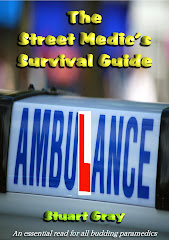
Street Medic - second print

The reprinted version of 'The Street Medic's Survival Guide' is now available through SP Services and my usual stockists. There were a few minor quality faults that I felt the need to redress, so I have worked on them and replaced every single stock copy of the book with a new, improved version!

Faults
The text was printed too close to the margins of the pages, making it difficult to read without breaking the spine, so I have increased the margin slightly. Unfortunately, increasing the margin increases the page number and I am reluctant to send more trees to their deaths for the sake of a minor flaw, so I have only increased it enough to make the book perfectly readable on opening. There are now 84 pages instead of 80.


There were also a couple of very minor typo's. On page 21 the CRB note has been inadvertently cut, so it is incomplete. It should read 'CRB - soon to change; from October 2009 the Independent Safeguarding Authority (ISA) will hold information on individuals which will be available free to employers and organisations wishing to check if their prospective employee can work with children and vulnerable people. Other ‘regulated activities’ will be covered and if you aren’t registered - or are barred from certain activities, then your Service may not be able to employ you.'

I have simplified the page heading and page number footers so they look cleaner and the widows and orphans (lonely single lines at the beginning and end of the pages) have been repaired.

On page 79 'Zulu zulu' should read 'Zebra zebra'!

About three spelling/grammatical errors were also identified and repaired.

And that's it. First print editions do tend to carry the teething problems associated with deadlines, so I hope I have now sorted things out. If you have a copy of the book, it is a rarity now because only a few thousand were printed with the errors. You can now go off and Ebay it!

If you are starting Paramedic Science or are thinking of going into frontline Paramedicine, click on the link (the post title), go to SP and buy the book!!

Xf

Tuesday, 10 November 2009

Fits and faints

Day shift: Four calls; one taken by car; one assisted-only and two by ambulance.

Stats: 1 EP fit; 1 Abdo pain; 1 Faint; 1 eTOH fit.


The whole of the morning disappeared in a flash as I ran around getting my comms sorted out and waiting for a patient. Then as lunch time crept in, I was sent to a 40 year-old man who was fitting in a cafe. He was post ictal and recovering slowly when I arrived; he made no sense yet but I managed to confirm with him that he was epileptic.

The lady running the cafe said he’d fitted for 15 minutes but I found that unlikely – two of the customers said that he’d only been down for 5 minutes. So, I spent another twenty minutes with him as he attempted, time and time again, to push me out of his way so that he could wander around. He was a good few inches taller than me so he became a handful at times and I was glad to see the ambulance pull up.

By the time he’d been checked out again by the crew, he was almost fully back to normal and he was given a lift round the corner to his workplace – he refused to go to hospital.


Immediately after this call, I made my way to an abdo pain in a restaurant, where my CRU colleague was attending a 33 year-old woman with a history of endometriosis, normally controlled by monthly injections of GnRH analogue. Her pain was so severe that entonox did nothing for it, so she was given a few mls of morphine and that did the trick. She was needle-phobic, so after persuading her to have the analgesic, I inserted the slowest cannula I’ve ever done into her arm – I had to talk her through every millimetre of what I was doing. She felt nothing and I may have convinced her that injections aren’t so bad after all, who knows?


A 45 year-old fainted at work and lay in the reception area with colleagues around her as she recovered. The woman is taking antibiotics and this may be a factor; not the drugs themselves but any stressors that affect her if she is currently suffering from depression. It’s a common enough problem. A crew arrived and took her away after my initial obs revealed no physical problems.


The last job of the shift took me to the Leicester Square area for a 33 year-old Polish alcoholic who had ‘fitted’ in a doorway. Several MOPs had called it in because they were concerned but I reassured them and spent twenty minutes with the man trying to translate his Polish into English, or as near as dammit, as his friend looked on. He didn’t want to go to hospital and his hands were very cold, so I wrote down the name and location of the nearest hostel and gave it to him. He won’t go there; he’ll hunt for alcohol instead because that’s what he does. I felt sorry for him but then dismissed it because there are many, many unfortunate people around me who don’t drink themselves into a stupor every day. I should feel sorry for them instead.

Be safe.

Monday, 9 November 2009

Glass children

Day shift: Six calls: one treated on scene; one false alarm; one by car; two assisted-only and one by ambulance.

Stats: 1 Fracture; 1 Cold turkey druggie; 1 Not choking child; 1 Faint; 1 eTOH; 1 Minor cut.


A few things have caught my eye recently and I thought I’d share them with you to brighten your day (if it’s dull). I was watching a news item on the war in Afghanistan when the Chief of the Defence Staff appeared for an interview. He was named as Sir Jock Stirrup and this had me smiling. There’s no way on Earth he got through the Academy without a few million jibes at his name (and for my American friends, if translation is needed, the man can be called ‘Jock strap’)

I drive through Camden on my way to work every morning and there is a building with a sign on the outside that states ‘Jews for Jesus’. I find this confusing and paradoxical – can anyone tell me what that is all about?

And finally, a little courier van runs around Central London with the statement ‘my little sister is a bike’ liveried upon its side. Funny and close I think... reminds me of a broken optician's sign I once saw in which the only two letters that were missing were the ‘i’s. These little things make me smile.


I had to scrape the first of this winter’s frost off my car windows this morning before I left for work and by 7.30am it still hadn’t warmed up enough to remove the slip risk from the roads, so my first call, for a fall with fracture wasn’t a great surprise.

The 69 year-old woman had slipped on spilled milk that had been left in the road outside a tube station. The liquid had frozen and she had skidded onto her wrist, landing hard enough to give her a Colles’ fracture. Her wrist was badly deformed and the pain quite severe, although entonox helped somewhat. I put her injured arm in a sling and took her to hospital in the car. Her taxi-driver husband followed in his cab and they both went into Resus.

The patient told me she recognised me from a job I did much earlier in the year at a bank where she works; luckily she had a positive memory of me – it’s a small world.


A few hours later and after several cancelled calls, including one in which a woman was described as ‘incontinent’ and nothing else, I was asked to check out a man who was lying in the street vomiting. A police officer was on scene and all he wanted to do was move the man along but he was a little concerned about the fact that he was throwing up. He described the man as ‘anti-police’ and felt that I would be able to communicate with him and persuade him to move.

The drug addict was cold turkey and vomiting comes with that territory, so he didn’t want to go to hospital. It was an impractical notion anyway because his large black dog was with him, lying under the ragged, filthy sleeping bag with his owner. He barked a warning to me several times but I wasn’t worried because these animals tend to be well cared for and less territorial than house-bound pets. They have a natural inclination to protect their masters, of course but most of them recognise the uniform and understand that we mean no harm.

I persuaded the young man to move on and tried to interest him in the local hostel, which may have been able to support him through a very tough time but he wasn’t interested. Meanwhile the dog came out from underneath its cover and began to lick up the stream of watery, bile-coloured vomit that the man had left trailing out into the gutter. That wasn’t pleasant to watch and my attempts to discourage the animal from lapping it up came to nothing as he blatantly ignored me. He was wagging his tail, so he must have been enjoying it.


On to a non-event with a ‘choking’ call for a 2-year-old who stuck a passport photo in her mouth and retched a few times. The call was made by her mother and by the time I arrived there was nothing more to see. The little girl was understandably quiet and shy about having me around and at first declined, by means of a reluctant attitude, my request to inspect her throat. I was happy to leave her with mum but I needed to know she was out of danger. The first clue I got that all was okay was when she indicated that she wanted a drink of juice from her little plastic cup and then mum offered her breast milk, which she took there and then. I figured if she could suckle, she had no trouble breathing and I wasn’t going to consider her age for too long because every mother and child will continue that feeding bond until they both feel it’s no longer required. I reckon after the age of sixteen it should be outlawed though.


I managed to get lunch in before my next call of the shift. This one took me south of the river for what, I imagine, my Control desk thought to be a straight-forward pick up and convey job after a 22 year-old female fainted in a university lecture theatre. Unusually, it wasn’t that simple. The young girl had a recent history of bilateral pulmonary embolism and was on Warfarin as a result. She was due to have a catheter inserted in her heart and today she appeared to faint and fit just before taking an exam. Now, this kind of stress can and does produce the household type faints that we are all used to running on but don’t worry too much about and so it was prudent just to send me along but this lady had a complicated history and that changed the colour of things, so I requested an ambulance. She had chest pain and was emotionally wired, so travelling to hospital in the car was not an option.


A false alarm in Soho later on as I chatted to a colleague in Frith Street. Someone dialled 999 then left the ‘phone off the hook and ‘shouting’ could be heard in the background. I went around the corner to where the call had originated, followed by my CRU colleague and saw nothing initially, although I could certainly hear the shouting. It was one of those distinctive random cries that tend to emanate from the drunk or insane (or both) and it wasn’t long before we identified the source of it. A drunken (and probably drugged up) man was wandering down the street yelling, dancing and trying to sing. He looked harmless and even approached us to shake our hands. No emergency there then.


And once again, just as the time approached to end my shift, I was sent miles north and out of area to attend a 2 year-old boy who had bumped his head on a wooden bed post and cut himself above the eye. It was a very superficial wound and needed no more than a few strips of tape to close it. The young mother, who already had another two older children, seemed to have no idea whatsoever about the difference between a simple first aid issue and a true emergency. She dialled 999 because her little boy cut his head – he wasn’t unconscious and displayed no complications whatsoever. This lack of a basic understanding of childhood injuries leaves me stunned. You don’t need lessons for this because you experience it yourself in life (well, most of us do). Obviously an ambulance had never been despatched to this; they’d sent me simply because they knew it was a nonsense call but somebody had to deal with it. It’s frustrating to have to advise grown up people, especially parents, over and over again, to do a first aid course and get some confidence. Please, we are running out of ambulances.

Be safe.